
Three levels of sedation, chosen with you rather than for you — so the appointment you have been putting off can finally happen.
Some people put off a cleaning for six months. Others put off a filling for six years, and by the time they call, the tooth needs a crown instead. Almost nobody in that second group is being careless. They are managing something real — a bad experience they still remember in detail, a gag reflex that makes the simplest appointment feel unbearable, a body that does not go numb the way the textbooks say it should.
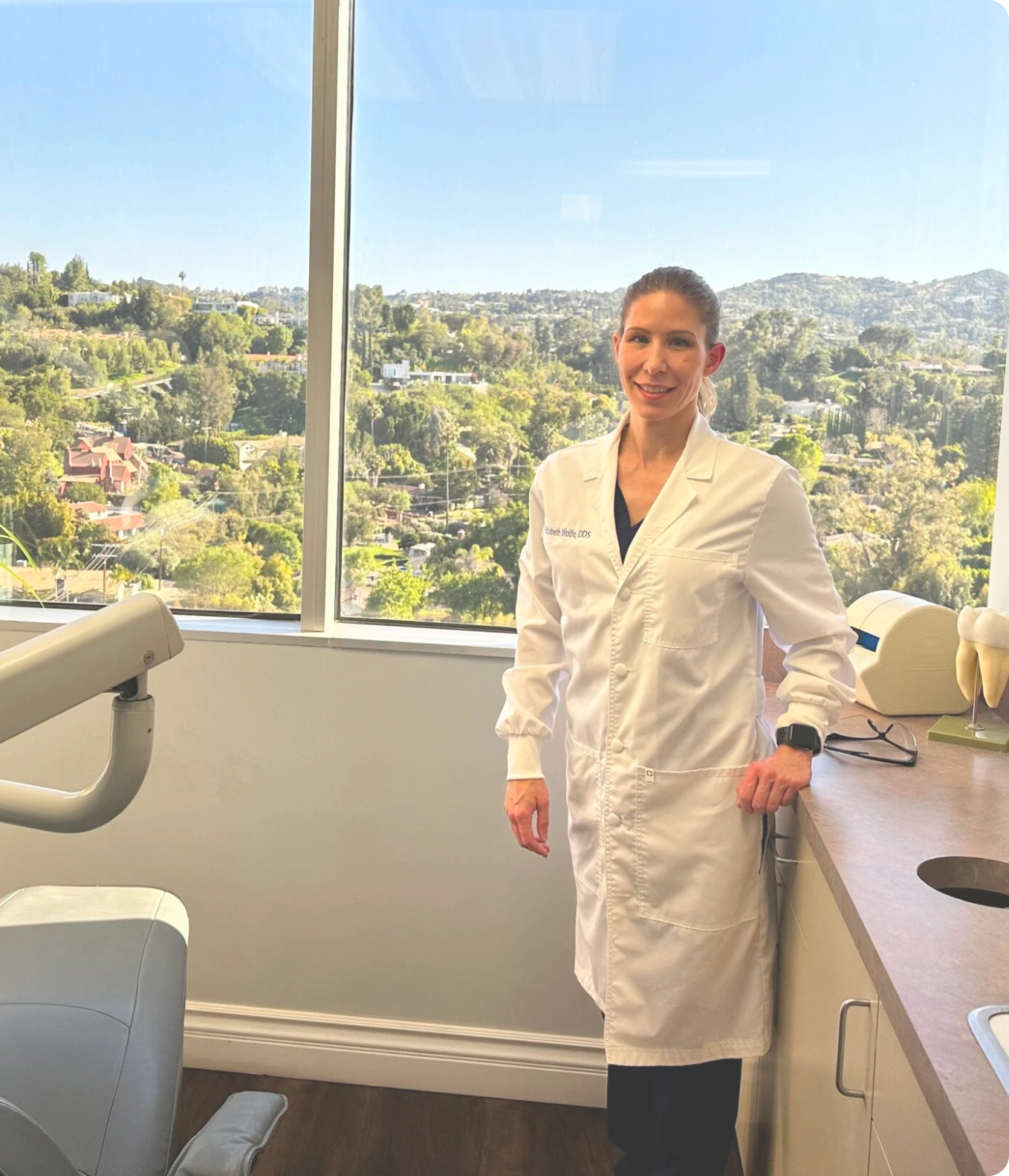
Sedation is not a luxury add-on for those patients. It is the difference between treatment happening and treatment not happening. At Encino Gentle Dental, Dr. Elizabeth Wolfe offers three levels of it, and the conversation about which one fits you starts before anyone picks up an instrument.
“Sedation” covers a lot of ground, and the differences are worth understanding before you choose. Here is what each one is actually like.
If you are in pain right now rather than planning a visit, our emergency dental care page covers same-day appointments.
A blend of nitrous oxide and oxygen, breathed through a small nosepiece for the length of your appointment. You stay awake and able to answer questions. What changes is the edge: the tightness in your chest loosens, time moves differently, and the sounds that usually set you off stop mattering as much. Most people describe it as floating, or as not caring in a pleasant way.
The reason nitrous is the workhorse of comfort dentistry is how quickly it reverses. We turn the nitrous off and give you a few minutes of pure oxygen, and it clears. You can drive yourself home, go back to work, and eat normally. There is no hangover and no escort required. For a great many anxious patients, nitrous plus an unhurried appointment and a dentist who narrates what she is doing is the entire answer.
A sedative taken by mouth a set time before your appointment, prescribed after Dr. Wolfe reviews your medical history and your full medication list. You arrive already relaxed. You remain conscious and able to respond, but the experience blurs — most patients remember the appointment only in fragments, which for someone carrying a traumatic dental memory is often the point.
Oral sedation asks more of you logistically. Because the medication is still working when the appointment ends, you cannot drive. Someone has to bring you and take you home, and you will want the rest of the day clear. The office gives you written instructions on when to take the pill, what you may eat beforehand, and which of your regular medications to take or hold.
For the deepest level of sedation, Dr. Wolfe brings in a licensed dental anesthesiologist who administers and monitors the sedation while she performs the dentistry. That division of labor is deliberate and it is the safer arrangement: one clinician is responsible for your airway, your blood pressure and your oxygen saturation for the entire appointment, and that is the only thing they are doing. Dr. Wolfe does not administer IV sedation herself.
Medication is delivered through a small line in your arm or hand, which means the level can be adjusted moment to moment rather than committed to in advance. Most patients have no memory of the appointment at all. It is the option that makes it possible to complete several procedures in one visit instead of six separate appointments a nervous patient would have to talk themselves into six times.
IV sedation is scheduled rather than same-day, because it requires the anesthesiologist’s availability, a pre-sedation health review, fasting beforehand, and an adult to take you home and stay with you afterward.
Not by a form, and not by whoever answers the phone. Sedation is a medical decision, and it starts with a consultation where nothing is done to your teeth.
Practices tend to say “your safety is our priority” and leave it there. Here is what it consists of.
For nitrous, almost nothing changes. Eat a light meal, arrive as usual, and expect to leave under your own steam.
For oral or IV sedation, the shape of the day is different and worth planning for. You will get exact instructions from the office, but broadly: you will be told when to stop eating and drinking, which regular medications to take, and when to arrive. Wear something comfortable with sleeves that move easily. Bring your driver. Expect to be groggy for the rest of the day and to remember very little, which surprises people who assumed they would be reliving it all evening.
One practical note about this building: it has valet parking, and the office fully validates it for treatment appointments. If your driver is dropping you off and collecting you later, that is worth knowing in advance.
If what you are carrying is more emotional than procedural, our page on care for anxious patients covers how appointments here are structured to give you control — the stop signal, the pacing, the narration. Read more about care for anxious patients.
Sedation is billed separately from the dental treatment, and the fee depends on which level you choose and how long the appointment runs. Which means we cannot give you a figure until we know what treatment you need and how long it will take — and that comes from the examination. Once it is known, you get it in writing, for the sedation and the dentistry both, before you agree to anything. Doing sums in your head while you are already nervous is its own kind of stress, and it is not one you should have to carry in here.
On insurance, we will be straightforward with you. Encino Gentle Dental is a fee-for-service practice. Dr. Wolfe is in network with Aetna, and for Aetna PPO plans we accept assignment of benefits at the contracted rates. With every other PPO she is out of network. That is a deliberate choice about how she is able to treat you rather than a barrier between you and care, and we will still bill your plan for you. We will still bill your PPO as a courtesy; the insurer reimburses you directly. Dental plans cover sedation inconsistently, so we will tell you what to expect from yours rather than let you find out afterward. The full picture on payment plans and insurance is set out on its own page.
We accept cash, checks, Zelle and all major credit cards, and we work with third-party financing so a longer treatment plan can be paid monthly. Read more about new patients.
One small thing we would ask of you. Sedation appointments are long and are built around a particular clinician’s day, so if something comes up and you need to move yours, two business days’ notice means we can offer the time to someone else who has been waiting for it. Life happens — just call us as early as you can.
This gets a section of its own because it genuinely affects how safely we can look after you. Sedatives relax the muscles that hold the upper airway open, which is precisely the airway that is already collapsing in someone with obstructive sleep apnea. It does not rule out sedation. It changes how it is planned, which level is appropriate, and how closely you are watched.
So we will ask you a few things, and none of them are a test. Do you snore? Are you tired during the day even when you have slept enough? Has anyone ever told you that you stop breathing at night? Do you have a CPAP — and if you have one you rarely wear, please tell us. Around half of the people prescribed one stop using it, and we would far rather know than guess. If you have been diagnosed, bring the sleep study.
To be clear about the boundary: sleep apnea is diagnosed by a physician through a sleep study, not by a dentist. What Dr. Wolfe does is screen, ask the questions a dental visit is a good opportunity to ask, and refer you to a board-certified sleep physician when the answers point that way. If a diagnosis already exists, she works alongside that physician. Read more about sleep and airway health.
Only under general anesthesia, which is not what any of these three options is. With nitrous and oral sedation you are awake and responsive. With IV sedation you are deeply relaxed and usually remember nothing, but you are still breathing on your own and still able to respond.
More people ask this than ask anything clinical, so if you have been embarrassed about wondering, please do not be — you are in very good company. The answer is no. Sedation makes people relaxed and sometimes a little chatty; it does not produce confessions. And whatever you did say, nobody in this room would think twice about it.
Yes, and it is a completely reasonable thing to want. If sedation is what makes a cleaning possible for you, then a cleaning with sedation is simply the right treatment. We would far rather see you twice a year with nitrous than once a decade without it.
Usually, but only after the interactions have been checked properly. Bring the actual list, including anything over the counter, anything herbal, and anything you take to sleep. This is the single most useful thing you can do to make your sedation appointment safe.
Children are assessed differently from adults, and pediatric sedation has its own rules and its own permit requirements. Call the office and describe your child’s situation and we will tell you honestly whether we are the right practice for it or whether you would be better served elsewhere. Read more about pediatric dentistry.
Minutes with nitrous. The rest of the day with oral sedation. The rest of the day and a quiet evening with IV sedation, with someone at home with you.
You do not have to commit to a procedure to find out what sedation would look like for you. Book a consultation, tell Dr. Wolfe what you are actually afraid of, and leave with a plan and a written estimate. Nothing gets done that day unless you want it done.
Call (818) 788-1231, or book online. 16311 Ventura Blvd, #1296, Encino, CA 91436. Tuesday 8:30–5:00, Wednesday 8:30–5:30, Thursday 8:00–5:00, Friday 7:00–3:00, and Saturday by appointment. Read more about contact.