Crowns and veneers both restore the appearance of a tooth, and that overlap is exactly why patients often ask for one when they actually need the other. The right choice comes down to a question that has nothing to do with preference: how much of the tooth’s structure is sound to begin with.
The short answer: a veneer covers only the front surface of a tooth and depends on healthy structure underneath. A crown covers the entire tooth and is the right choice when structure is compromised, whether from decay, a crack, or a large failing filling. If the concern is purely cosmetic and the tooth is structurally healthy, a veneer is usually the more conservative option.
What a veneer actually is
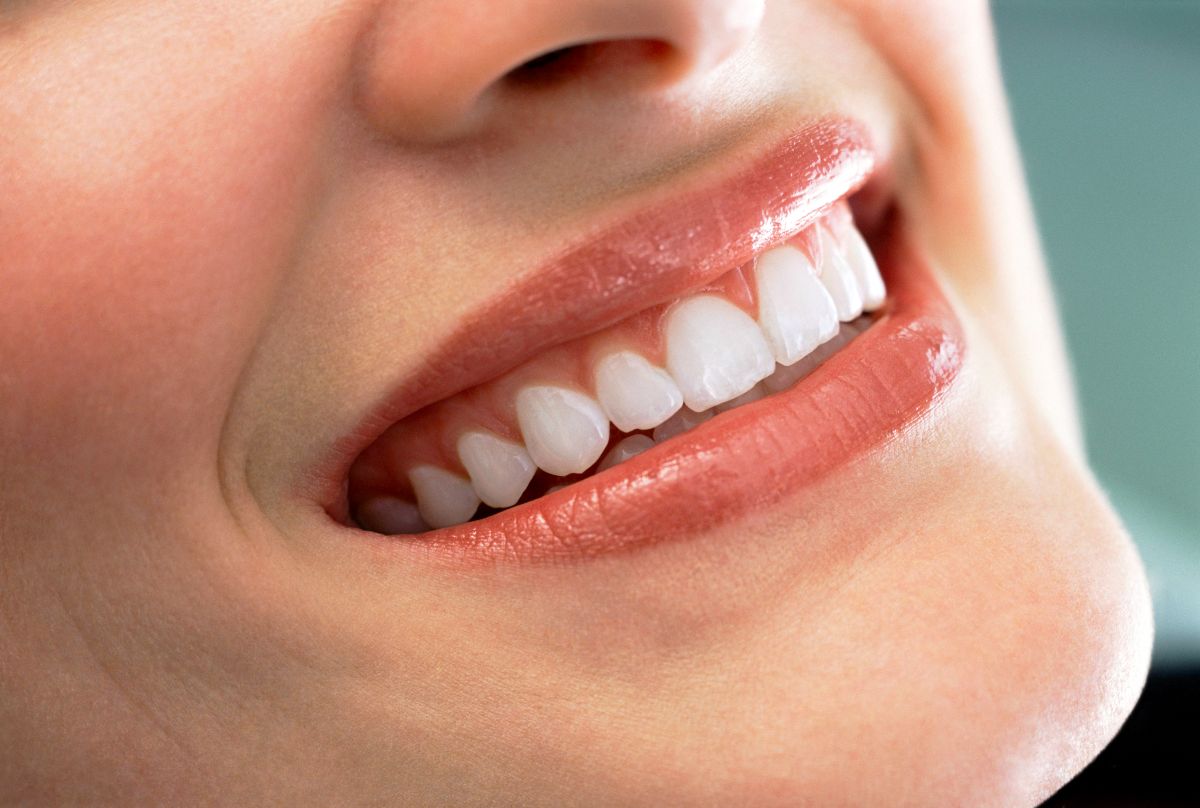
A veneer is a thin shell, typically porcelain, bonded to the front surface of a tooth. It is designed to change how a tooth looks, correcting shape, color, or minor alignment issues, while leaving most of the tooth’s original structure in place. Because a veneer only covers the visible front surface, it depends entirely on the tooth underneath being structurally sound. Our veneers page covers what veneers can address and how they are placed.
What a crown actually is
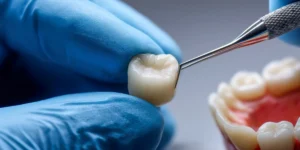
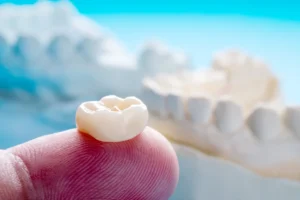
A crown covers the entire visible portion of a tooth, not just the front surface. It is the appropriate choice when a tooth has lost enough structure that a thin shell would not have anything solid to bond to, or when the tooth needs to withstand full biting force across its whole surface rather than just the front. Our crown page covers the full process, from evaluation through placement.
When a veneer is not enough
A veneer is not built to compensate for missing structural support. If any of the following apply, a crown is typically the more appropriate choice, even if the original concern started as cosmetic:
- The tooth has a large existing filling that is failing or covers a significant portion of the tooth. Our fillings page covers when a filling is the right restoration and when it has reached its limit
- There is a visible crack or the tooth has previously fractured
- Decay has affected more than the front surface of the tooth
- The tooth has had a root canal, which changes its structural properties. Here is why root canal-treated teeth specifically need a crown
- The bite places heavy force on the tooth, such as a back molar used for chewing
In these situations, bonding a thin shell to the front of the tooth does not address the underlying problem. A crown restores the whole tooth and distributes bite force across it, rather than concentrating pressure at a vulnerable point.
When a veneer is genuinely the better choice
For a tooth that is structurally sound and the concern is purely how it looks, whether that is shape, minor chips, discoloration that has not responded to whitening, or small gaps, a veneer is the more conservative option. It requires less removal of the natural tooth than a crown and is often the right call for front teeth being addressed primarily for cosmetic reasons. This is also why an evaluation matters before deciding: two teeth that look similarly imperfect from the outside can have very different amounts of healthy structure underneath.
Can a tooth have both a filling, a crown, and a veneer at different points?
Yes, and this is common. Front teeth used mainly for appearance are more often candidates for veneers, while back molars that handle heavy chewing force are more often candidates for crowns. Some patients have a mix, such as veneers on visible front teeth and a crown on a molar that had a large filling or a crack. Inlays and onlays also exist as a middle option for teeth with moderate damage that does not require a full crown but is too extensive for a standard filling.
Crown vs. veneer at a glance
| Veneer | Crown |
|---|---|
| Covers the front surface only | Covers the entire tooth |
| Requires a structurally sound tooth underneath | Restores teeth with significant structural loss |
| Best for purely cosmetic concerns | Best when strength and full bite support are needed |
| Common on visible front teeth | Common on molars and teeth with cracks, large fillings, or root canals |
| Less removal of natural tooth structure | More tooth structure is shaped to support full coverage |
Frequently asked questions
Can I get a veneer instead of a crown to save my natural tooth?
Only if the tooth has enough healthy structure to support it. A veneer bonded over a tooth with significant decay, a crack, or a large failing filling does not have a stable enough foundation and is likely to fail. In that situation, a crown is the option that actually protects the tooth long term.
Is a crown more expensive than a veneer?
Cost depends on the material and the specific case, and the two are not always directly comparable since they solve different problems. The more relevant question is which one your tooth actually needs, since placing the wrong restoration for the situation tends to cost more in the long run through redone work.
Do veneers and crowns look different from each other?
Both can be made to blend naturally with surrounding teeth when properly shade-matched and shaped. The visual difference between a well-made veneer and a well-made crown on a front tooth is usually minimal to an outside observer.
Can a veneer be upgraded to a crown later if needed?
Yes. If a tooth with a veneer develops a crack, new decay, or other structural issues later on, a crown can be placed at that point. The reverse is generally not true, since a tooth prepared for a crown has more structure removed than one prepared for a veneer.
What this looks like at our Encino practice
Dr. Wolfe evaluates each tooth individually rather than starting from a preferred treatment and working backward. That means the recommendation, whether a veneer, a crown, or something more conservative like a filling or an inlay, is based on what the tooth actually needs to hold up over time. Our approach to care covers how these decisions are made, and patients from Encino, Sherman Oaks, Studio City, Calabasas, and Tarzana are welcome to schedule an evaluation to find out which option fits their situation.
If you are unsure which one applies to you, that uncertainty is common and easy to resolve with a direct look at the tooth rather than guessing from the outside. The same goes for cost: how we quote either option is set out before any treatment is scheduled.